
Workflow
Text-to-Video vs. Image-to-Video: Which Should You Use?
A practical comparison of text-to-video and image-to-video for control, consistency, speed, source fidelity, and multi-shot production.
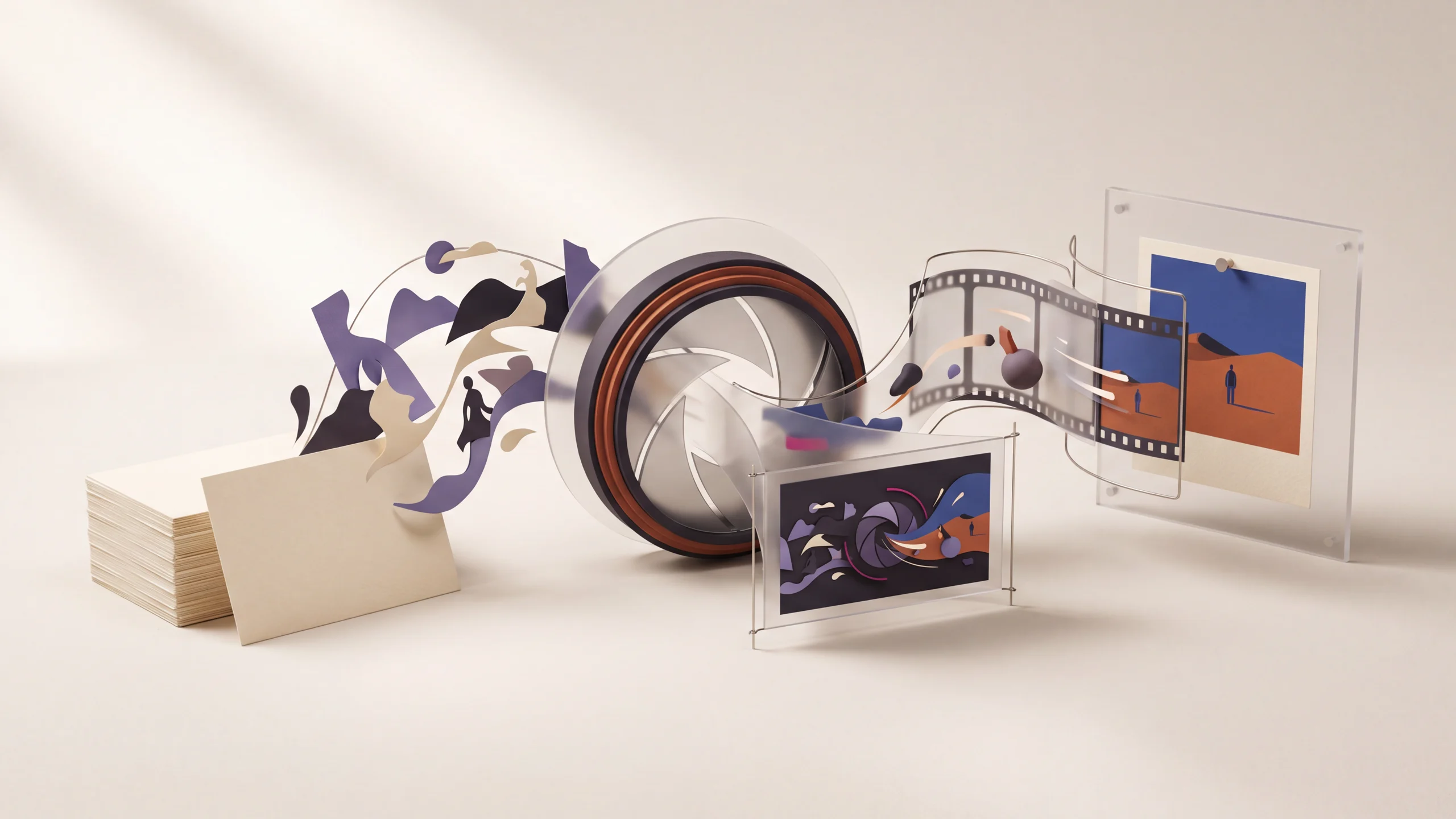
Text-to-video and image-to-video solve different starting problems. Text-to-video asks a model to invent the first frame and the motion. Image-to-video gives it a visual starting point and asks it to decide how that picture changes over time.
Neither method is universally better. Choose based on what is already approved, which details must stay fixed, and whether the shot is for exploration or production continuity.
The practical difference is who defines frame one
In text-to-video, your prompt must establish the subject, composition, setting, lighting, style, and motion. The model has broad room to interpret all of them. That makes the method powerful for ideation and harder to constrain when a visual detail must be exact.
In image-to-video, the source image already establishes most of the visible scene. The prompt’s main job is to direct subject movement, environmental movement, camera behavior, timing, and the desired end state.
Think of the difference this way:
- text-to-video begins with a written shot request;
- image-to-video begins with an approved frame plus motion direction.
Both methods still generate new frames, so neither guarantees perfect continuity or physical accuracy. The source image is an anchor, not a contract.
Choose text-to-video when exploration is the job
Text-to-video is a strong starting point when you know the idea but do not yet have the picture.
It suits:
- establishing shots for an imagined location;
- visual metaphors and conceptual transitions;
- abstract or atmospheric material;
- early mood exploration;
- shots where exact character or product identity is not critical;
- creating several distinct directions from the same brief.
Because the model creates the composition, the first results can reveal approaches you would not have designed as still images. That variability is useful during discovery.
The same freedom becomes a limitation when stakeholders already approved a specific subject, package, room, pose, or layout. Adding more adjectives may narrow the result, but the model is still inventing what the prompt does not lock visually.
Wide establishing shot of a silent greenhouse on the roof of a dense city at blue hour. A gardener in a yellow rain jacket walks between rows of tall plants while condensation runs down the glass. The camera performs a slow forward glide from outside to inside. Cool skyline, warm practical lights beneath the leaves, restrained documentary realism, continuous movement.
This prompt needs to define appearance and motion because no source frame exists.
Choose image-to-video when frame one matters
Image-to-video is usually the more direct choice when you already have an approved visual source.
It suits:
- animating a product photograph or designed pack shot;
- moving from a character reference or approved portrait;
- bringing album artwork or an illustration into motion;
- preserving a deliberate composition, palette, or set design;
- adding camera or environmental movement to a still;
- creating related clips from a consistent set of keyframes.
The quality of the source matters. A blurry subject, impossible anatomy, hidden hands, inconsistent reflections, or a composition with no room for movement gives the video model a difficult starting problem.
Use an image that can plausibly become the opening frame. If the subject must walk forward but the source cuts off both legs, the prompt cannot restore information with guaranteed accuracy. If the camera must pan right, the model will need to invent whatever lies outside the original picture.
The gardener takes two slow steps along the path and brushes one leaf with her right hand. Condensation continues to trail down the glass. The camera makes a gentle forward push while the city lights remain soft in the distance. Continuous, unhurried movement; she finishes facing the next row of plants.
Notice what is missing: the prompt does not redescribe the jacket, greenhouse, palette, or initial framing. The source image already carries that information.
Compare the methods on the constraint that matters
“Which one makes better video?” is too broad. Use the production constraint to decide.
Creative range
Text-to-video generally gives the model more room to invent the scene. Use that range when several interpretations are welcome. Image-to-video intentionally narrows the starting appearance.
Composition control
An approved image gives you direct control over frame one. Text can request a composition, but the model still interprets placement, scale, pose, and negative space.
Character and product fidelity
Image-to-video begins from visible identity and design evidence, so it is normally the more appropriate method when fidelity matters. The identity can still drift during difficult motion. Text-to-video is a weaker choice for exact packaging, interfaces, or recognizable people without supported references.
Motion freedom
Text-to-video can stage movement without inheriting a fixed pose. Image-to-video motion must grow plausibly from the source. A strongly posed still may resist an action that contradicts its balance or camera angle.
Multi-shot continuity
Independent text-to-video generations may reinterpret the character and world from shot to shot. A set of approved keyframes can give image-to-video shots a shared visual foundation, although each clip still needs review.
Iteration speed
Text-to-video is fast when the frame is disposable and the idea is open. Image-to-video can be faster once the image is approved, because visual debates happen before motion generation. If creating the source frame takes many rounds, that preparation is part of the real cost.
Source truth
Neither method should be trusted to reproduce exact factual details that were never supplied. Product interfaces, data, labels, and claims should come from approved assets and be checked in the final cut.
For production, combine the methods deliberately
A hybrid workflow separates visual development from motion production.
1. Explore the world
Use written briefs, sketches, existing assets, or text-driven generation to discover the character, environment, palette, and composition.
2. Approve keyframes
Create a still for each important shot or shot family. Check identity, wardrobe, product details, lighting direction, screen direction, and room for the planned movement.
3. Animate the approved frames
Use image-to-video prompts that describe motion and timing. Keep the visual description stable unless a scene change is intentional.
4. Use text-to-video for connective material
Generate atmosphere, cutaways, abstract transitions, and establishing shots where exact anchors are less important.
5. Edit and compare adjacent shots
Continuity exists between clips, not only inside them. Check eyelines, end poses, camera direction, light, and scale at every cut.
This hybrid is especially useful for character-led stories, product sequences, explainers with designed frames, and music videos with a consistent visual world.
Prompt the information the model does not already have
For text-to-video, a reliable starting structure is:
[Framing and camera] of [subject] [visible action] in [setting]. [Light, palette, and visual treatment]. [Environmental and camera movement]. [Timing or end state].
For image-to-video, strip the prompt back:
The subject [action]. [Environment changes]. The camera [movement]. [Pace, sequence, or end state].
Use positive, observable direction. “Locked camera; the frame remains still” describes a result more clearly than a list of camera moves you do not want. Begin simply, generate, and revise the largest mismatch one category at a time.
Match the fix to the failure
The text-to-video frame is attractive but wrong
Identify the highest-priority mismatch: subject, composition, setting, look, or motion. Rewrite that category and preserve the wording that already worked. If an exact visual is non-negotiable, stop trying to describe it and provide an image.
The image-to-video clip barely moves
Check whether the requested action is compatible with the source pose. Use one visible action, clarify the camera behavior, and give the motion a beginning and end.
The image-to-video clip loses the subject
Reduce motion, duration, occlusion, or camera difficulty. Test a readable angle. For a recurring person, use the continuity process in our consistent-character guide.
Multiple clips do not belong together
Create a shared identity and style packet, reuse approved references, and plan neighboring shots as pairs. Consistency is rarely fixed by adding the word “same” to every prompt.
Product details change during motion
Reduce how much the product rotates or becomes obscured. Use real product footage or stills for details that must remain exact, and add labels and interface text during editing.
Frequently asked questions
Is image-to-video always more consistent?
It provides a stronger starting visual, but difficult motion, long duration, occlusion, or model behavior can still cause drift. Consistency must be reviewed across the full clip and between shots.
Can I turn a text-to-video result into an image-to-video reference?
Yes. Choose an approved frame, clean up any issues, and use it as a keyframe for related shots where the workflow supports that input.
Which method is better for product videos?
Use approved product imagery or footage when design fidelity matters. Text-to-video can support environments and concepts, while image-to-video can animate controlled product frames. Check all labels, proportions, and claims in the final edit.
Which method is better for beginners?
The easier method depends on the starting asset. Text-to-video is direct for open-ended ideas. Image-to-video is often clearer when you can point to an approved picture and describe only the movement.
Can I use both methods in one finished video?
Yes. A viewer does not care which generator made each shot; they care whether the sequence is coherent. Match color, texture, camera language, pacing, and continuity during the edit.
Sources and further reading
This guide was written by the Brevity editorial team from the linked primary guidance and practical shot-planning methods. Model capabilities and controls change; verify the current product variant before production.